
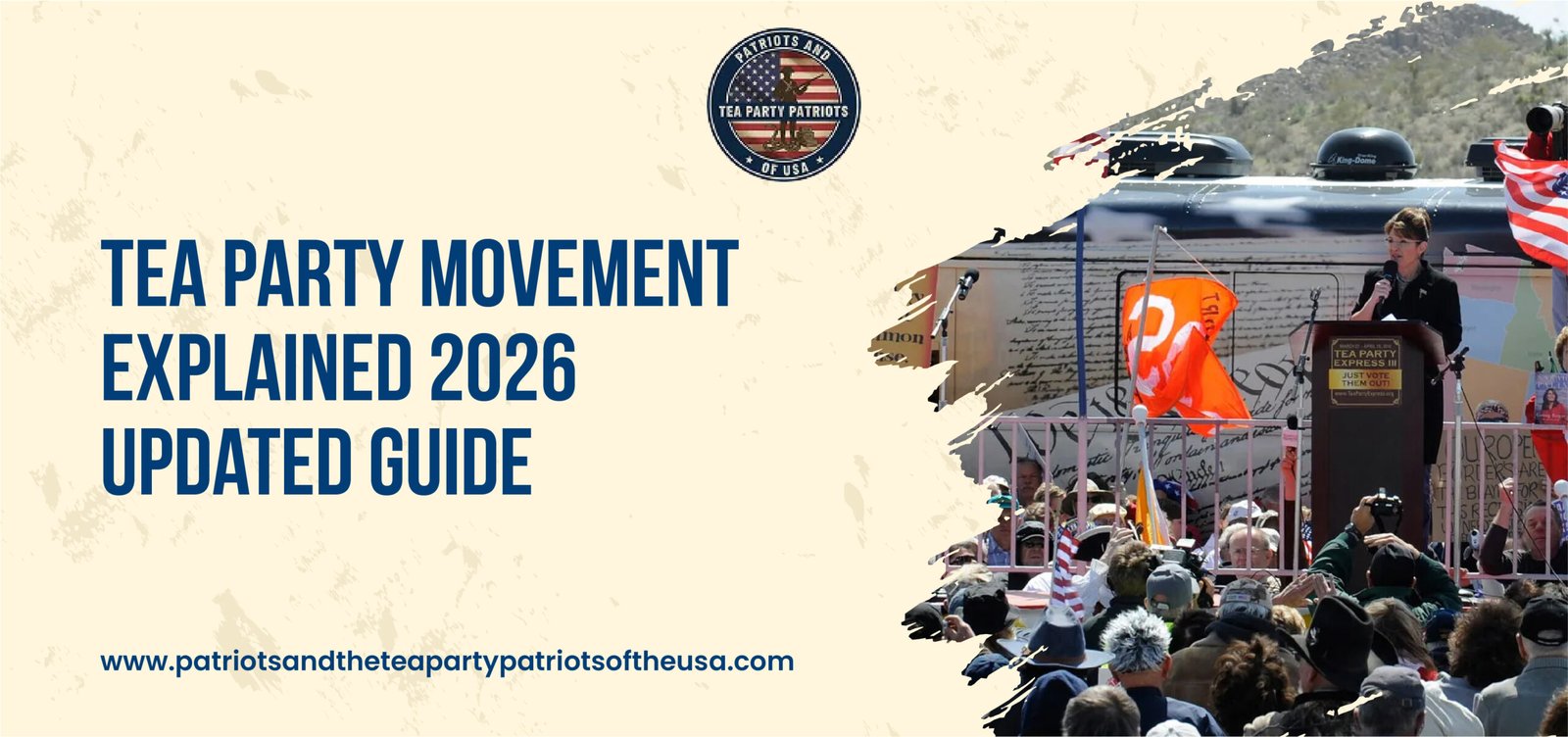
If you’ve heard the term ‘Tea Party’ but aren’t sure what it really means — or if you know the history and want to get involved — this is your complete guide. We’ll cover where the movement came from, what it stands for today, how it’s organized, and how you can find a chapter in your state.
WHAT IS THE TEA PARTY MOVEMENT?
A Grassroots Revolt Against Government Overreach
The Tea Party movement is a decentralized, grassroots political movement in the United States that emerged in 2009 in response to federal government expansion, bailout spending, and rising national debt. Unlike political parties, the Tea Party isn’t a top-down organization — it’s a collection of local, state, and national groups united by shared principles.
The name is a nod to the Boston Tea Party of 1773, when American colonists dumped British tea into Boston Harbor to protest ‘taxation without representation.’ The modern Tea Party movement echoes that same demand: government should be accountable to the citizens it represents.
A BRIEF HISTORY – From CNBC Rant to National Movement
On February 19, 2009, CNBC commentator Rick Santelli delivered an on-air rant from the floor of the Chicago Mercantile Exchange, calling for a ‘tea party’ to protest the federal mortgage relief plan. Within days, protest events were being organized across the country.
By April 15, 2009 — Tax Day — hundreds of simultaneous Tea Party rallies had taken place in cities across all 50 states. The movement had gone national in less than two months, entirely through grassroots organizing and social media — no party infrastructure, no major funding, no professional organizers.
In the 2010 midterm elections, Tea Party-backed candidates flipped 63 seats in the House of Representatives — the largest midterm wave in over 60 years. The movement had proven it could translate grassroots energy into electoral results.
CORE BELIEFS – What the Tea Party Stands For
While the Tea Party is not monolithic, most chapters and members organize around these core principles:
▸ Fiscal Responsibility — Stop the spending, cut the debt, balance the budget
▸ Limited Government — Washington is too big, too expensive, and too intrusive
▸ Free Markets — Economic freedom, not government-directed economies
▸ Constitutional Governance — The Constitution means what it says
▸ Individual Sovereignty — Your rights come from God and the Constitution, not from government
HOW IT’S ORGANIZED TODAY – 500+ Chapters Across All 50 States
Today the Tea Party movement operates through a network of local chapters, state-level organizations, and national groups like Patriots USA. Each chapter is independently organized and led, but all share a common set of values and a commitment to constitutional governance.
Patriots USA alone counts 500+ local chapters, 50,000+ active members, and 1,200+ events organized per year. Local chapters hold meetings, organize rallies, host candidate forums, and coordinate voter outreach — all at the community level.
HOW TO JOIN – Find a Tea Party Patriots Chapter in Your State
Getting involved is easier than you think. Most chapters hold monthly meetings open to the public, require no dues to attend, and welcome first-timers.
▸ Step 1: Use our chapter finder to locate a group in your county or city
▸ Step 2: Attend a meeting — no commitment required for your first visit
▸ Step 3: Get on the mailing list for alerts, events, and action items
▸ Step 4: Show up to local events, rallies, and voter drives
Tea Party Movement — Frequently Asked Questions
Is the Tea Party a political party?
No. The Tea Party is a grassroots movement, not a registered political party. Members vote in Republican and sometimes Libertarian primaries, but the movement itself has no official ballot status.
Is the Tea Party still active in 2026?
Yes. While media coverage has fluctuated, the grassroots infrastructure — local chapters, state organizations, and national networks — remains active and growing. Many originally Tea Party-aligned activists are now embedded in local Republican party leadership.
What’s the difference between the Tea Party and MAGA?
Both movements share priorities: limited government, immigration enforcement, and America-first economic policy. The Tea Party movement predates MAGA and tends to place heavier emphasis on fiscal conservatism and constitutional originalism. Many Tea Party activists are also Trump supporters.